Is It ADHD or Perimenopause? Why Women in Their 40s Are Getting the Wrong Answer
Hormone Health · Perimenopause
Is It ADHD or Perimenopause? Why Women in Their 40s Are Getting the Wrong Answer
A woman sits in my Dallas office and says something I hear almost every week.
"I think I have ADHD."
She’s 42. Or 47. Or 51. She has never struggled with focus before. She graduated college, built a career, raised children, ran a household, and managed schedules and deadlines for decades without thinking twice.
But now she cannot remember why she walked into a room. She starts projects and never finishes them. She forgets appointments. She loses her train of thought mid-sentence. Tasks she used to handle on autopilot feel overwhelming. She is exhausted. And increasingly, she is walking out of someone’s office with an ADHD diagnosis.
Here is the part I want women in Dallas to understand before they accept that answer.
The Short Version
Perimenopause can produce the exact cognitive symptoms most people associate with ADHD. Brain fog, forgetfulness, trouble concentrating, low motivation, and mental fatigue are all common during the hormonal transition that begins in your late 30s and 40s. For a woman who never had attention problems before, a shifting hormonal environment is often the piece of the conversation no one mentioned.
ADHD is real, and it is genuinely underdiagnosed in women, because girls and women often never showed the hyperactive symptoms people expect. So sometimes the answer is yes, this is ADHD that went unrecognized for years.
But ADHD is not the only explanation. And in women over 40, perimenopause is one of the most commonly missed ones.
The Hormonal Transition Nobody Prepared Us For
Most women think menopause arrives with hot flashes. In reality the transition usually starts years earlier and announces itself in the brain first.
Perimenopause can begin in a woman’s late 30s or early 40s. During this stretch, hormone levels become increasingly unpredictable. Estrogen swings. Progesterone declines. Testosterone slowly drops. Sleep quality changes. Stress resilience changes.
None of this stays in the reproductive lane. Estrogen, progesterone, and testosterone all act on the brain, shaping neurotransmitters, sleep architecture, memory, concentration, and motivation. When those hormones start moving, women often notice the cognitive symptoms long before they notice anything happening with their cycle.
“I Feel Like I’ve Lost My Edge”
This is the phrase I hear most. Not "I’m having hot flashes." Not "my periods are irregular." What women actually say is:
- “I don’t feel as sharp.”
- “I can’t keep up with my inbox anymore.”
- “I feel mentally scattered.”
- “I don’t recognize the way my brain works now.”
The executive who suddenly cannot stay on top of her workload. The teacher who cannot pull up names she has known for years. The business owner who feels foggy by mid-afternoon. The mother who is overwhelmed by a routine she used to run in her sleep. The questions start. Am I burned out? Am I depressed? Am I anxious? Do I have ADHD?
Sometimes the answer to one of those is yes. But sometimes the real answer is that her brain is responding to a changing hormonal environment, and no one ever told her that was on the table.
The Symptoms Almost Nobody Connects
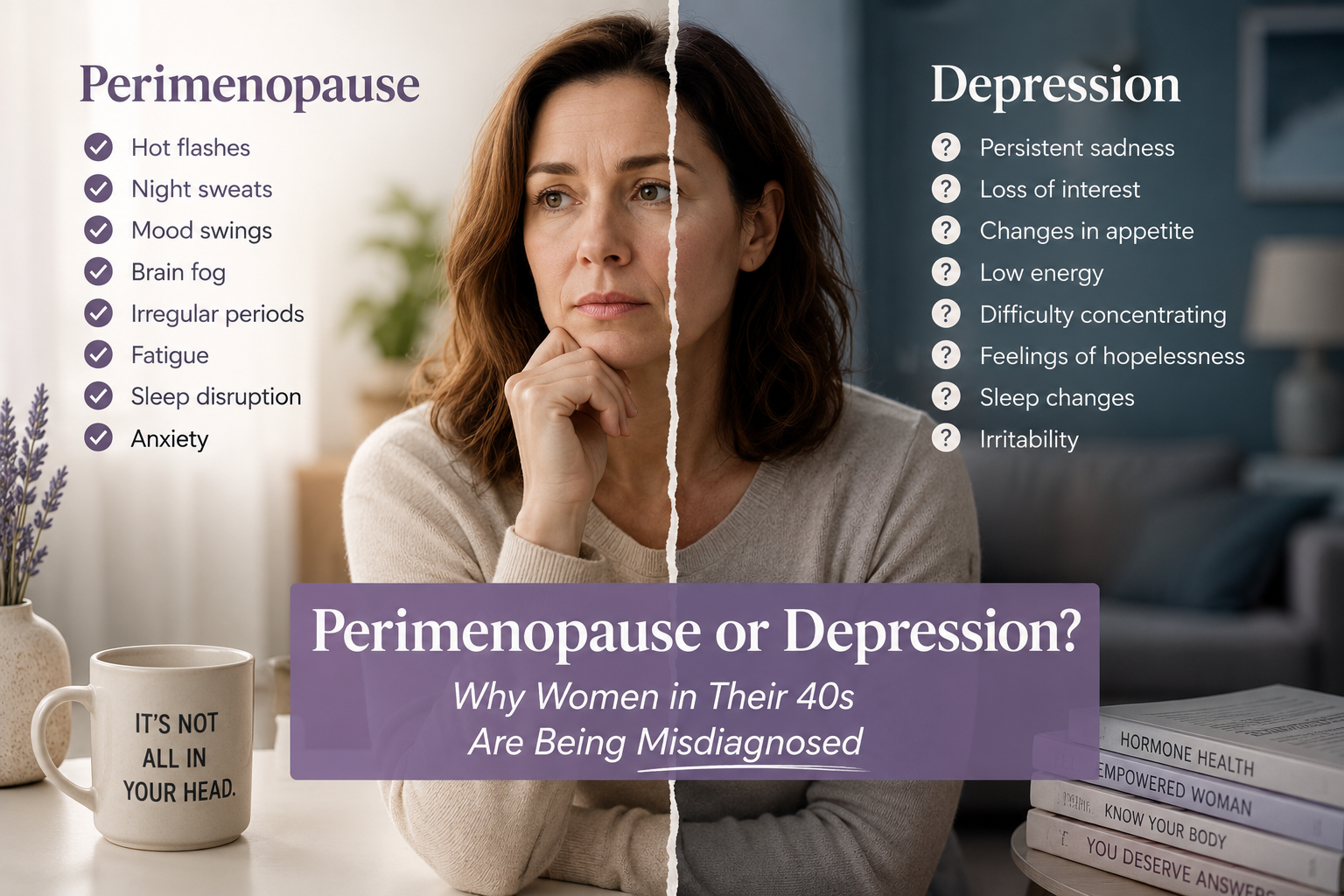
When women learn that perimenopause can drive the following, the lightbulb usually goes on:
- Brain fog and difficulty concentrating
- Forgetfulness and word-finding trouble
- Reduced motivation and mental fatigue
- Increased anxiety and irritability
- Poor sleep and daytime exhaustion
- A shorter fuse for stress
- A quiet loss of confidence
When several of those land at once, of course it looks like ADHD. The symptom overlap is real, and it is why the misattribution happens so often.
Why Sleep Matters More Than We Realize
One of the biggest drivers of cognitive symptoms in perimenopause is sleep disruption. Many women start waking between 2 and 4 a.m. like clockwork. Others cannot fall asleep or cannot stay asleep. A lot of them do not realize how badly their sleep has eroded until they actually start tracking it.
The brain cannot perform when it is not recovering. Poor sleep on its own can manufacture symptoms that look almost identical to an attention deficit. Address the sleep and the hormones behind it, and the "ADHD" often looks very different.
This Isn’t About Blaming Everything on Hormones
One of the biggest mistakes in medicine is assuming every symptom has a single cause. Not every woman with brain fog is in perimenopause. Not every woman with concentration problems has ADHD. Not every woman with fatigue has a hormone imbalance.
The goal is not to pin everything on hormones. The goal is to make sure hormones are part of the workup instead of the thing nobody checked. For too many women, the changes tied to one of the most significant biological transitions of their lives never even made it into the conversation.
You Are Not Broken
This is the part I want every woman to hear.
You are not failing.
You are not lazy.
You are not losing your mind.
And you are not imagining your symptoms.
Your body is changing. Your hormones are changing. Your needs are changing. And there are answers, and there are options. The first step is recognizing that what you are experiencing has a name. Sometimes that name is ADHD. Sometimes it is burnout. Sometimes it is anxiety. And sometimes it is perimenopause. Nobody should spend years wondering what happened to the woman they used to be.
Getting Evaluated in Dallas
At Navara Health in North Dallas, we work up the whole picture instead of handing you a single label. That means looking at your hormones, your thyroid, your sleep, and your symptoms together, so you understand what is actually driving the way you feel. If perimenopause is part of the story, you will know, and you will have real options to address it.
We see women from across Dallas, Plano, Frisco, Addison, and Richardson, with telehealth available throughout Texas for anyone who prefers to be seen from home. If you have been told it is probably ADHD, or anxiety, or just stress, and something about that answer never sat right, it may be worth asking the question no one asked you.
Frequently Asked Questions
Can perimenopause cause ADHD-like symptoms?
Yes. Perimenopause commonly causes brain fog, forgetfulness, trouble concentrating, low motivation, and mental fatigue, which overlap heavily with the symptoms of ADHD. In women over 40 who never had attention problems before, hormonal change is a frequent and frequently missed cause.
At what age does perimenopause start?
It often begins in the late 30s or early 40s, several years before periods stop. The cognitive and mood symptoms can show up long before hot flashes or irregular cycles.
Why do I suddenly feel foggy and forgetful in my 40s?
Shifting estrogen, declining progesterone, and falling testosterone all affect memory, focus, and sleep. When those changes combine with disrupted sleep, the result can feel like a noticeable drop in mental sharpness.
Should I get tested for ADHD or have my hormones checked first?
It is not one or the other. The most useful approach is a workup that looks at hormones, thyroid, and sleep alongside your symptom history, so you are not given a single label before the obvious physiological causes have been ruled in or out.
Can hormone changes really affect memory and concentration?
Yes. Estrogen, progesterone, and testosterone act directly on the brain and influence neurotransmitters tied to memory, attention, and motivation, which is why many women notice cognitive changes during perimenopause before anything else.
Where can I get evaluated for perimenopause in Dallas?
Navara Health in North Dallas evaluates women for perimenopause, hormone changes, and thyroid issues, and offers telehealth across Texas. You can call (469) 653-3124 or email contact@navarahealthtx.com to schedule.
Navara Health
Ready to find out what’s actually going on?
Book a Hormone Consultation Dallas, Texas
Telehealth available in TX, CO, CT, FL, IA, OK, VT, VA, and WA.
Recent Posts